
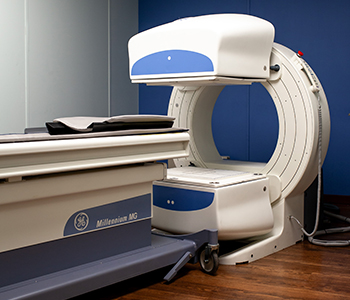
The nuclear medicine camera at Cedar County Memorial Hospital, installed in May of 2026.photo of a nuclear medicine camera machine
Nuclear Medicine
Cedar County Memorial Hospital now offers nuclear medicine imaging with competitive pricing. Information for providers about specific tests we offer is available here.
What is Nuclear Medicine?
If your doctor has recommended a nuclear medicine scan, you might have questions about how it works and what to expect. Think of nuclear medicine as a way for us to see how your body is functioning on the inside, helping us catch health issues earlier than a standard X-ray or CT scan.Unlike traditional imaging that takes a "picture" from the outside, nuclear medicine works from the inside out. We use a tiny amount of a specialized material called a radiopharmaceutical to see your organs and tissues in action.
How does it work?
Depending on the test, you’ll either swallow, inhale, or receive a small injection of the radiopharmaceutical. This substance is naturally attracted to specific areas—like your heart, lungs, or bones. As the substance travels through your body, it sends out a faint signal. A special camera detects these signals to create a map of how your organs are performing.Is it safe?
It’s completely natural to feel a bit nervous when you hear the word "radioactive." However, nuclear medicine is one of the safest imaging tools available today.Low Dose: The amount of radiation you receive is very small—often similar to what you’d get from a routine X-ray.
Precision: Because it can spot changes at the molecular level, it often identifies issues long before they would show up on other tests.
Versatility: While mostly used for diagnosis, these same principles can be used to treat certain conditions, like thyroid issues or bone pain, with incredible precision.
Why Choose Nuclear Medicine?
Traditional radiology (like X-rays) shows us what your body looks like (anatomy). Nuclear medicine shows us how your body works (function). By seeing how your heart pumps or your kidneys filter, your care team can create a treatment plan that is much more accurate and personalized for you.Preparing for Your Nuclear Medicine Visit
To make your experience as smooth as possible, we have compiled the most common questions and a guide on how to dress for your appointment.What to Wear
Comfort is key! For most scans, you can stay in your own clothes as long as they follow these guidelines:●Comfortable Clothing: Wear loose-fitting, comfortable attire, such as soft cotton clothing.
●Skip the Metal: Try to avoid clothes with metal zippers, buttons, or underwires, as these can interfere with the scan.
●Leave Jewelry at Home: Please remove jewelry, watches, and metallic hair accessories before your scan.
●Layers are Best: Imaging rooms are kept cool for the equipment, so bringing a light jacket or sweater (without metal) is a good idea if you are sensitive to cool temperatures.
Frequently Asked Questions
How long will the appointment take?The time varies greatly depending on the type of scan. Some take only 30 to 60 minutes, while others—like bone scans—may require you to receive an injection and then return 3 to 4 hours later for the actual imaging.
Do I need to fast (not eat)?
For some tests (like those for the heart or gallbladder), you may need to fast for 4 to 6 hours. For others, like bone scans, you can eat and drink normally. We will give you specific instructions when you book your appointment.
Will I be radioactive after the scan?
You will have a very small amount of radioactivity in your body for a short time. Most of it leaves your system naturally within 24 hours. Drinking plenty of water after your test helps flush the material out faster.
Can I be around others?
Yes, you can resume normal activities immediately. While the radiation dose is minimal, we recommend avoiding prolonged, close contact with pregnant women or small infants (like sleeping in the same bed) for the remainder of the day.
What if I am claustrophobic?
Unlike MRI machines, the nuclear medicine camera is "open" and does not enclose you. If you have concerns, please let our team know so we can ensure you are comfortable.
When will I get my results?
A specialist will review your images and send a report to your doctor, typically within 24 to 48 hours. Your doctor will then contact you to discuss the findings.
CCMH Diagnostic Imaging Department
Phone Number: 417-876-3542Fax Number: 417-876-3957
Address: 1401 S. Park Street, El Dorado Springs, MO 64744